JOIN US AT THE ASH ANNUAL MEETING FOR A PRESENTATION ON ENJAYMO  |  MONDAY 12/12 @ 8 am

Not an official event of the 64th ASH Annual Meeting and Exposition. This presentation is not sponsored or endorsed by ASH. Not CME-accredited. MAT-US-2208046-v1.0-11/2022

VISIT US AT ASH  |  DECEMBER 10-13  |  BOOTH #643

Not an official event of the 64th ASH Annual Meeting and Exposition. This presentation is not sponsored or endorsed by ASH. Not CME-accredited. MAT-US-2208046-v1.0-11/2022

ENJAYMO is the first and only approved treatment for Cold Agglutinin Disease (CAD)1,2

ENJAYMO is a classical complement inhibitor indicated for the treatment of hemolysis in adults with Cold Agglutinin Disease.2,3

ENJAYMO worked fast within 1 week to inhibit complement-mediated hemolysis

90% inhibition of the complement pathway was observed following a single dose of ENJAYMO and sustained when ENJAYMO concentrations were 100 mcg/mL2

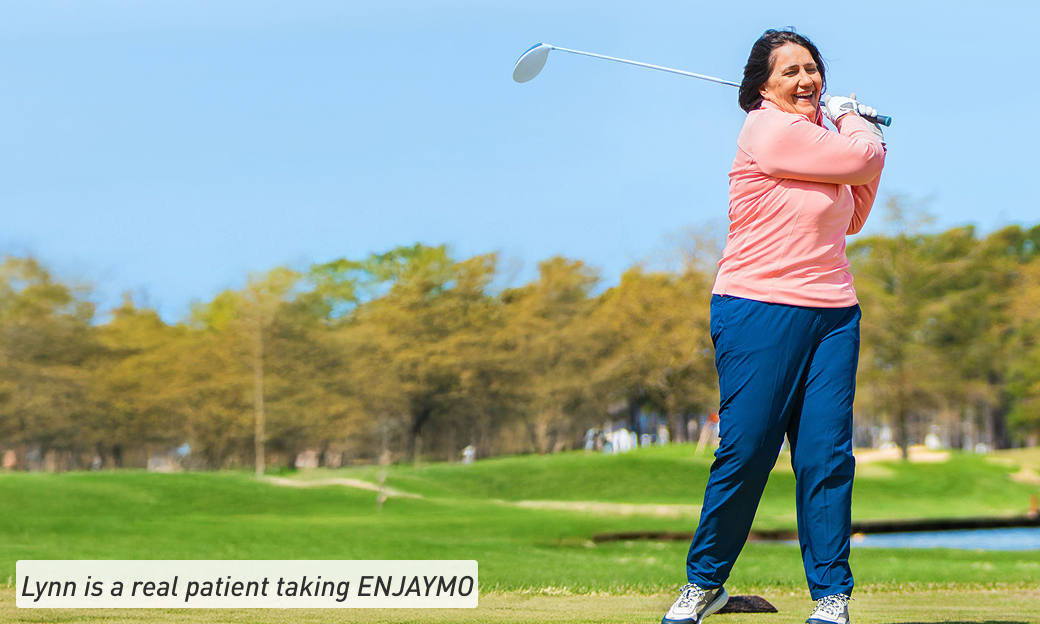
woman golfing

ENJAYMO specifically targets and blocks classical complement-mediated hemolysis in Cold Agglutinin Disease at C1s2,4-6

Without ENJAYMO
With ENJAYMO

Autoplay
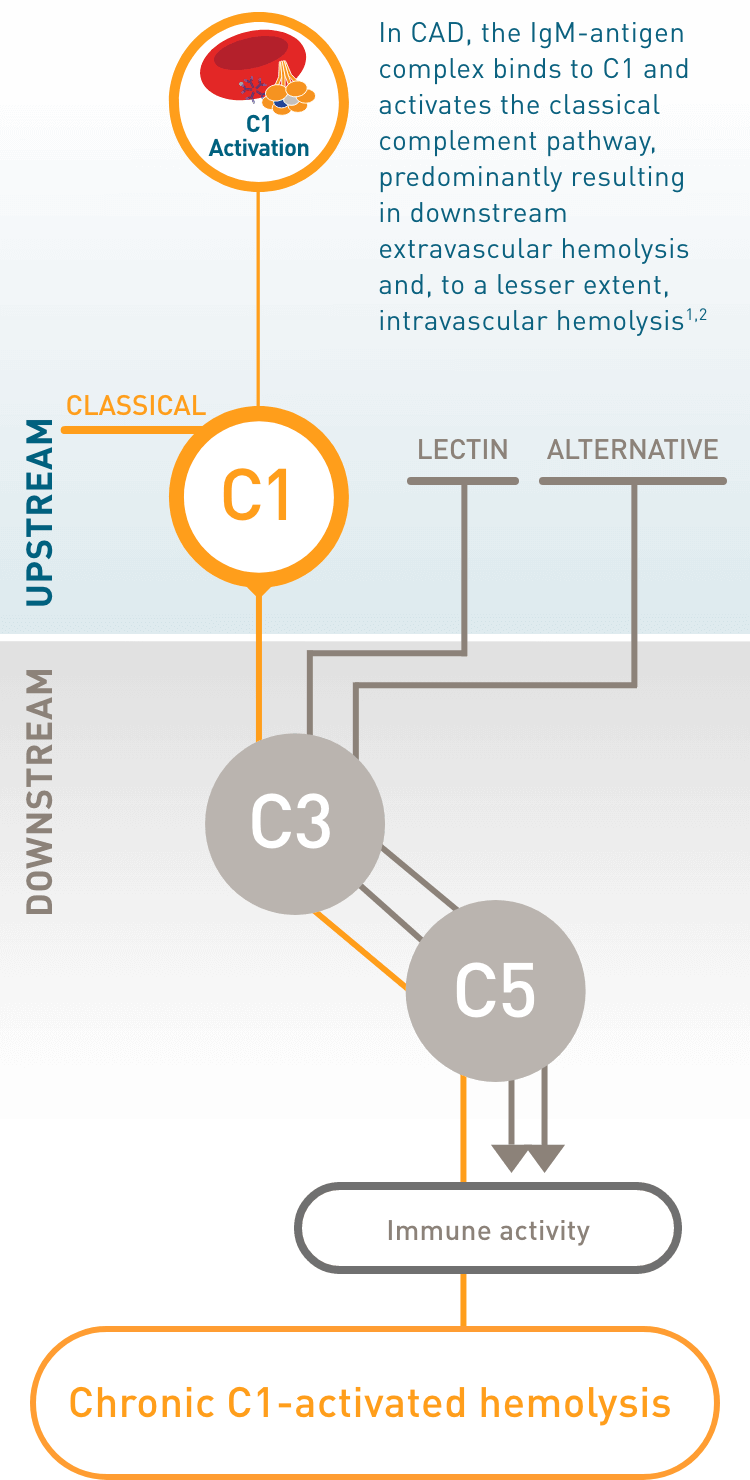
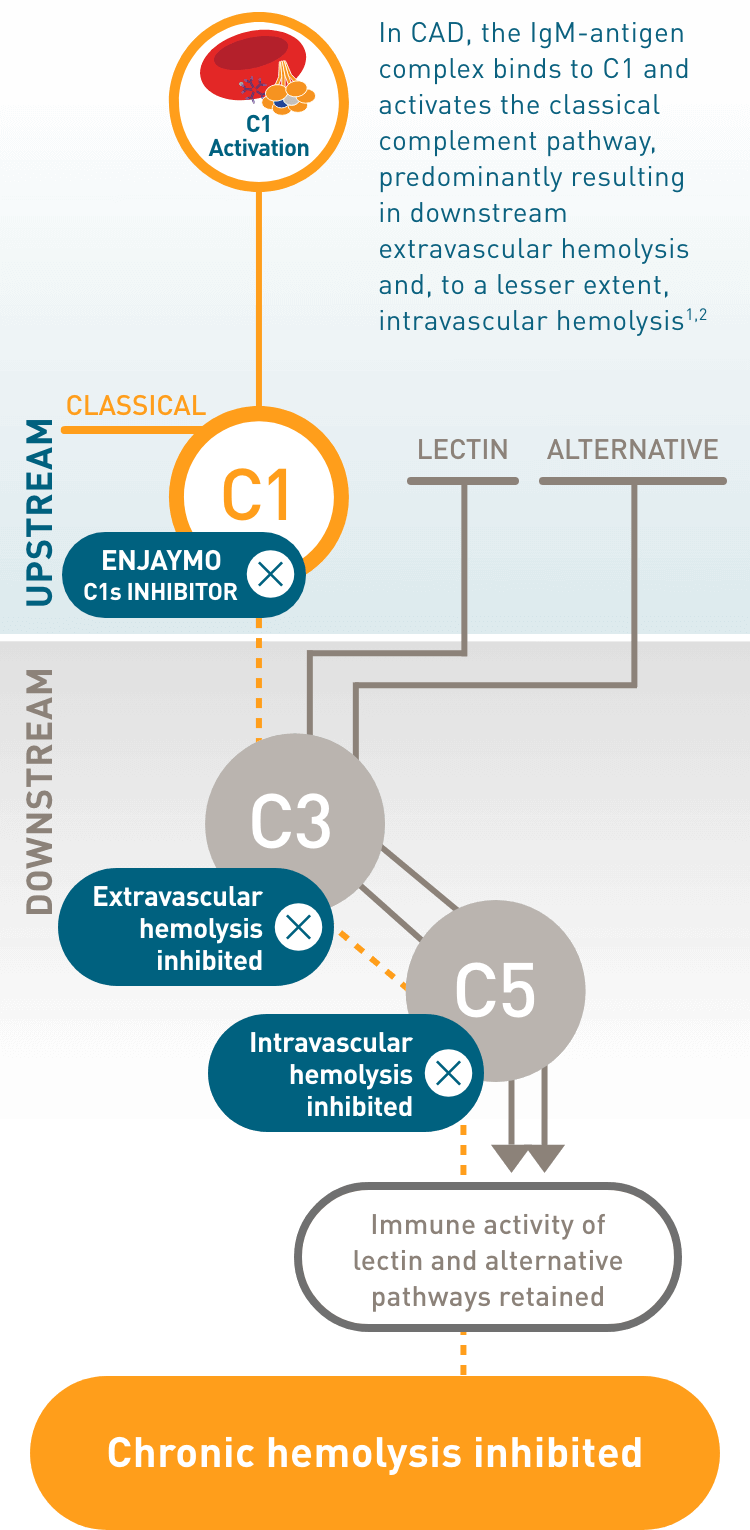
DOWNSTREAM UPSTREAM In CAD, the IgM-antigen complex binds to C1 and activates the classical complement pathway, predominantly resulting in downstream extravascular hemolysis and, to a lesser extent, intravascular hemolysis ALTERNATIVE LECTIN C3 CLASSICAL Immune activity C1 C5 Chronic C1-activated hemolysis C1 Activation Hemolysis in CAD
DOWNSTREAM UPSTREAM In CAD, the IgM-antigen complex binds to C1 and activates the classical complement pathway, predominantly resulting in downstream extravascular hemolysis and, to a lesser extent, intravascular hemolysis ALTERNATIVE LECTIN C3 CLASSICAL Immune activity of lectin and alternative pathways retained C1 C5 Hemolysis inhibited Preventing downstream extravascular hemolysis, the predominant form of hemolysis in Cold Agglutinin Disease Preventing downstream intravascular hemolysis Preserving the important immune surveillance activities of the lectin and alternative pathways* ENJAYMO, a C1s inhibitor, blocks C1 upstream in the classical complement pathway: C1 Activation ENJAYMO C1s INHIBITOR E xtravascular hemolysis inhibited Intravascular hemolysis inhibited ENJAYMO in CAD

ENJAYMO, a C1s inhibitor, blocks C1 upstream in the classical complement pathway:

  • Preventing downstream extravascular hemolysis, the predominant form of hemolysis in CAD
  • Preventing downstream intravascular hemolysis
  • Preserving the important immune surveillance activities of the lectin and alternative pathways*

*Based on ENJAYMO preclinical data evaluations, both lectin and alternative pathways were not inhibited in vivo or ex vivo. Further data supporting that the alternative pathway was not inhibited by ENJAYMO were found using clinical assays in phase 1 and phase 3 clinical trials.

Watch how ENJAYMO works to inhibit complement-mediated hemolysis at C1s2,4-6

Pharmacodynamic data show inhibiting complement-mediated hemolysis at C1s started with the first dose of ENJAYMO2

ENJAYMO works fast within 1 week to inhibit complement-mediated hemolysis

90% inhibition of the classical complement pathway was observed following a single dose of ENJAYMO and sustained when ENJAYMO concentrations were 100 mcg/mL2

1 DOSE
1 dose

In 1 dose, ENJAYMO demonstrated inhibition of complement-mediated hemolysis at C1s

  • >1 g/dL increase in hemoglobin
  • Near normalization of bilirubin
1 DOSE EVERY 2 WEEKS
1 dose every 2 weeks

Continued use of ENJAYMO provided complete classical complement pathway inhibition, leading to inhibition of complement-mediated hemolysis evidenced by

  • Normalization of bilirubin
  • Decrease in LDH
  • Increase in haptoglobin
  • Decrease in reticulocytes

C4 levels returned to normal levels (0.2 g/L) in patients with CAD within one week.2,7

ENJAYMO HCP Indication and Important Safety Information

INDICATION

ENJAYMO® (sutimlimab-jome) is indicated for the treatment of hemolysis in adults with cold agglutinin disease (CAD).

IMPORTANT SAFETY INFORMATION

CONTRAINDICATIONS

ENJAYMO is contraindicated in patients with known hypersensitivity to sutimlimab-jome or any of the inactive ingredients.

WARNINGS AND PRECAUTIONS

Serious Infections Including Those Caused by Encapsulated Bacteria

  • ENJAYMO, a proximal classical complement C1s inhibitor, increases susceptibility to serious infections, including those caused by encapsulated bacteria e.g. Neisseria meningitidis (any serogroup, including non-groupable strains), Streptococcus pneumoniae, and Haemophilus influenzae type B.
  • Life-threatening and fatal infections with encapsulated bacteria have occurred in both vaccinated and unvaccinated patients treated with complement inhibitors.
  • Serious infections (bacterial and viral) were reported in 15% (10/66) of patients receiving ENJAYMO in the two phase 3 trials. These infections included urinary tract infection with sepsis, respiratory tract infection, pneumonia, otomastoiditis, and skin infections. One patient (1.5%) died due to Klebsiella pneumoniae.
  • Complete or update vaccination against encapsulated bacteria at least 2 weeks prior to administration of the first dose of ENJAYMO, according to the most current ACIP recommendations for patients receiving a complement inhibitor.
  • If urgent ENJAYMO therapy is indicated in a patient who is not up to date on their vaccine(s), administer as soon as possible.
  • Vaccination does not eliminate the risk of serious encapsulated bacterial infections. Closely monitor patients for early signs and symptoms of serious infection and evaluate patients immediately if an infection is suspected.
  • If ENJAYMO treatment is administered to patients with active systemic infections, monitor closely for signs and symptoms of worsening infection. Some infections may become rapidly life-threatening or fatal if not recognized and treated promptly. Inform patients of these signs and symptoms and steps to be taken to seek immediate medical care.
    • Consider interruption of ENJAYMO treatment in patients who are undergoing treatment for serious infection.
    • Consider patients’ immune status when initiating treatment with ENJAYMO.

Infusion-Related Reactions

  • Administration of ENJAYMO may result in infusion-related reactions. In the two phase 3 trials, 29% (19/66) of patients treated with ENJAYMO experienced infusion-related reactions. One patient permanently discontinued ENJAYMO due to an infusion-related reaction.
  • Monitor patients for infusion-related reactions and interrupt if a reaction occurs.
  • Discontinue ENJAYMO infusion and institute appropriate supportive measures if signs of hypersensitivity reactions, such as cardiovascular instability or respiratory compromise, occur.

Risk of Autoimmune Disease

  • Based on its mechanism of action, ENJAYMO may potentially increase the risk for developing autoimmune diseases such as systemic lupus erythematosus (SLE). Development of SLE has been associated with inherited classical complement deficiency.
  • In clinical trials, 4.5% (3/66) of patients developed a relapse or worsening of previously diagnosed autoimmune disease.
  • Monitor ENJAYMO patients for signs and symptoms and manage medically.

Recurrent Hemolysis After ENJAYMO Discontinuation

  • If treatment with ENJAYMO is interrupted, closely monitor patients for signs and symptoms of recurrent hemolysis, eg, elevated levels of total bilirubin or lactate dehydrogenase (LDH) accompanied by a decrease in hemoglobin, or reappearance of symptoms such as fatigue, dyspnea, palpitations, or hemoglobinuria. Consider restarting ENJAYMO if signs and symptoms of hemolysis occur after discontinuation.

ADVERSE REACTIONS

  • The most common adverse reactions in the CADENZA trial (Part A) (incidence 18%) are rhinitis, headache, hypertension, acrocyanosis, and Raynaud’s phenomenon. The most common adverse reactions in the CARDINAL trial (incidence 25%) are urinary tract infection, respiratory tract infection, bacterial infection, dizziness, fatigue, peripheral edema, arthralgia, cough, hypertension, and nausea.

Please see full Prescribing Information.

See the full Medication Guide.

Hb=hemoglobin; IgM=immunoglobulin M; LDH=lactate dehydrogenase.
References:
  1. FDA: Food and Drug Administration. FDA approves treatment for adults with rare type of anemia. FDA. February 4, 2022. Accessed October 28, 2025. https://www.fda.gov/drugs/news-events-human-drugs/fda-approves-treatment-adults-rare-type-anemia
  2. ENJAYMO. Prescribing information. Recordati Rare Diseases Inc.; 2024.
  3. Röth A, Berentsen S, Barcellini W, et al. Sutimlimab in patients with cold agglutinin disease: results of the randomized placebo-controlled phase 3 CADENZA trial. Blood. 2022;140(9):980-991. doi:10.1182/blood.2021014955
  4. Berentsen S. Complement activation and inhibition in autoimmune hemolytic anemia: focus on cold agglutinin disease. Semin Hematol. 2018;55(3):141-149. doi:10.1053/j.seminhematol.2018.04.002
  5. Shi J, Rose EL, Singh A, et al. TNT003, an inhibitor of the serine protease C1s, prevents complement activation induced by cold agglutinins. Blood. 2014;123(26):4015-22. doi:10.1182/blood-2014-02-556027
  6. Panicker S, Shi J, Rose E, et al. TNT009, a classical complement pathway specific inhibitor, prevents complement dependent hemolysis induced by cold agglutinin disease patient autoantibodies. Blood. 2013;122(21):42. doi:10.1182/blood.V122.21.42.42
  7. Röth A, Barcellini W, D'Sa S, et al. Sutimlimab in Cold Agglutinin Disease. N Engl J Med. 2021;384(14):1323-1334. doi:10.1056/nejmoa2027760
  8. Mullins M, Jiang X, Bylsma LC, et al. Cold agglutinin disease burden: a longitudinal analysis of anemia, medications, transfusions, and health care utilization. Blood Adv. 2017;1(13):839-848. doi:10.1182/bloodadvances.2017004390
expand arrow

ENJAYMO INDICATION

ENJAYMO® (sutimlimab-jome) is indicated for the treatment of hemolysis in adults with cold agglutinin disease (CAD).

IMPORTANT SAFETY INFORMATION

CONTRAINDICATIONS

ENJAYMO is contraindicated in patients with known hypersensitivity to sutimlimab-jome or any of the inactive ingredients.

WARNINGS AND PRECAUTIONS

Serious Infections Including Those Caused by Encapsulated Bacteria

  • ENJAYMO, a proximal classical complement C1s inhibitor, increases susceptibility to serious infections, including those caused by encapsulated bacteria e.g. Neisseria meningitidis (any serogroup, including non-groupable strains), Streptococcus pneumoniae, and Haemophilus influenzae type B…